
Kia Standard vs. Optional Equipment: What's Included & How to Verify
Search Window Sticker
Table of Contents
Key Takeaways
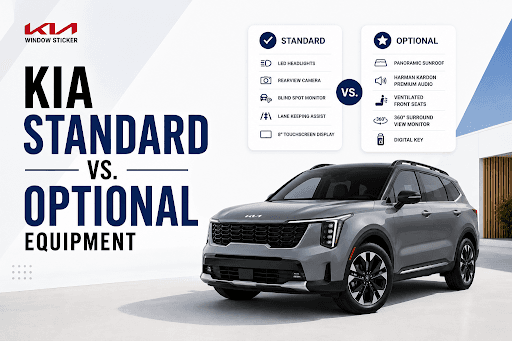
- A Kia standard equipment list outlines the features that come built into every car of a specific trim level.
- Kia optional equipment refers to extra factory-installed upgrades picked out by the original buyer.
- Dealer-installed accessories are completely different from factory options and won't show up on the original Monroney label.
- Pulling the original window sticker is the easiest way to verify which features were actually added at the factory.
- A window sticker by VIN check confirms the trim level, factory options, MSRP, and original specs before you buy or sell.
If you've ever compared two Kia vehicles that look almost identical but have totally different price tags, you're definitely not alone. One might come loaded with a panoramic sunroof, leather seats, and premium audio, while the other has basic cloth seats and fewer creature comforts.
At first glance, it's super easy to wonder why there's such a price gap. The answer usually comes down to standard equipment versus optional equipment.
Every Kia leaves the plant with a core list of features built into its trim level. From there, buyers can add extra factory-installed packages and upgrades before the car even gets assembled. Understanding the difference is super useful because it impacts the car's overall value, resale price, insurance costs, and your final buying decision.
What Is a Kia Standard Equipment List?
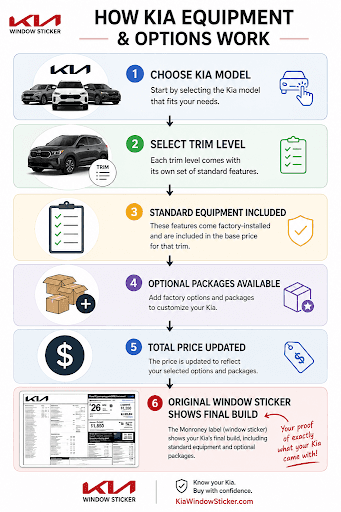
Standard equipment refers to the features Kia includes on every single car built for a specific trim level. These features are already baked into the car's base MSRP, so buyers don't pay anything extra to get them.
Think of it as the car's baseline. If you buy a Kia Sportage EX, every Sportage EX built for that model year comes with the exact same core gear. The same goes for trims like LX, S, GT-Line, or SX Prestige.
Standard equipment usually covers the powertrain, basic tech, safety systems, and core interior features. While the exact setup changes depending on the year, you'll usually see stuff like:
Category | Typical Standard Features |
Performance & Safety | Engine, transmission, Forward Collision-Avoidance Assist, Lane Keeping Assist, airbags. |
Infotainment | Touchscreen display, Apple CarPlay®, Android Auto™, Bluetooth®, USB ports. |
Convenience | Power windows, power door locks, remote keyless entry, air conditioning. |
Interior | Cloth seating, adjustable steering wheel, digital gauges. |
For instance, plenty of recent Kia Sportage trims include wireless Apple CarPlay, Android Auto, remote start, and a handful of driver assistance tools right off the line, while higher trims build on top of those with extra luxury tech.
One thing a lot of shoppers overlook is that "standard" doesn't mean every Kia shares the same features. A Telluride LX and a Telluride SX Prestige are both Tellurides, but their standard equipment lists look completely different. That's why knowing the specific trim level is just as crucial as knowing the model name.

Did You Know? Two Kias from the exact same model year can have thousands of dollars in price differences just because they belong to different trim levels or carry different factory packages.
READ ALSO: How to Find and Read Your Kia Window Sticker (Monroney Label)
What Is Kia Optional Equipment?
Optional equipment includes features that buyers explicitly chose to add before the car left the factory. Unlike standard equipment, these upgrades aren't included in the base price and show up as separate line items on the original Monroney label.
Rather than picking options one by one, Kia usually bundles several features into optional packages. This lets buyers customize their build without having to jump all the way up to a higher trim level.
For example, an original buyer ordering a new Kia might toss in:
 Panoramic sunroof
- Harman Kardon® premium audio system
- Heated and ventilated seats
- Leather upholstery
- Surround View Monitor
- Tow package
- Larger alloy wheels
- Premium paint color
These add-ons bump up the vehicle's MSRP and get listed individually on the factory window sticker.
Factory Options vs. Dealer-Installed Accessories
It's also super important to catch the difference between factory options and dealer-installed accessories. Factory options get installed during production and become part of the official build record. Dealer-installed accessories get slapped on after the car hits the lot and won't show up on the original window sticker.
Factory Options | Dealer-Installed Accessories |
Installed during manufacturing | Installed after delivery to the dealership |
Listed on the original Monroney label | May not appear on the window sticker |
Included in official factory build records | Usually documented on separate addendum sheets |
Affects the car's original MSRP | Often sold as extra dealership add-ons |
Common Kia Optional Equipment Packages
Package names shift depending on the model and year, but here are some of the most common factory options you'll run into across the Kia lineup:
Package | Typical Features |
Premium Package | Leather seating, premium audio, ventilated front seats. |
Technology Package | Larger touchscreen, navigation, advanced Drive Wise features. |
Sunroof Package | Panoramic sunroof, upgraded interior trim |
Tow Package | Tow hitch, wiring harness, towing hardware |
X-Line Package | Unique rugged styling, larger wheels, AWD enhancements |
Drive Wise Package | Additional safety and driver assistance tech |
The original window sticker also breaks down the individual MSRP for each package, making it super easy to see how much the original owner paid for every upgrade.
Standard vs. Optional Equipment: Key Differences
Now that we've covered the basics, let's stack them side-by-side.
One of the biggest mistakes used car shoppers make is assuming every car of the same model comes with identical equipment. In reality, two Kia Sorento EX models built in the same year can have totally different setups depending on which factory options were checked off.
Lets compare:
Standard Equipment | Optional Equipment |
Included in the base MSRP | Costs extra money |
Installed on every car of that trim level | Only installed if selected by the buyer |
Listed under Standard Equipment | Listed under Optional Equipment |
Defines the core features of the trim | Personalizes the specific build |
Cannot be deleted from that trim | May or may not be present on the car |
Here is a quick practical example using the Kia Sportage:
Feature | LX Trim | EX Trim |
Cloth Seats | Standard | — |
SynTex Seating | Optional / Higher Trim | Standard |
Panoramic Sunroof | Optional | Optional / Standard (varies by year) |
Dual-Zone Climate Control | — | Standard |
Wireless Apple CarPlay | Standard (varies by year) | Standard |
Premium Audio | Optional | Optional |
Notice how certain features shift from being an extra option on a lower trim to becoming standard equipment on a higher one. That's why simply knowing the model name isn't enough—you need the trim level and the exact factory packages too.
READ ALSO: Where Is the Kia VIN Number? How to Find It and Get Your Window Sticker
Why Do You Need to Know the Difference?
Knowing what's standard versus what's optional helps you make way smarter buying decisions.
Imagine you're cross-shopping two Kia Tellurides priced almost identically. One carries a Premium Package, panoramic sunroof, and Harman Kardon® audio, while the other is just a bare-bones base trim with zero options.
Without checking the original build specs, you could easily overpay for the plain one or miss out on a stellar deal.
Spotting these details also helps when you're:
- Negotiating a fair purchase price.
- Comparing two similar cars on different lots.
- Listing your Kia for sale with accurate specs.
- Estimating realistic resale values.
- Verifying if a seller's claims are actually legit.
How to Verify Your Kia's Features Using a Window Sticker VIN Check?
If you want a 100% accurate equipment list, pulling the VIN is the way to go. Every Kia carries a unique 17-digit VIN that unlocks its exact factory build details.
You can usually find the VIN:
- On the driver's side dashboard (looking through the windshield)
- Inside the driver's door jamb sticker
- On your vehicle registration paperwork
- Right on your insurance card
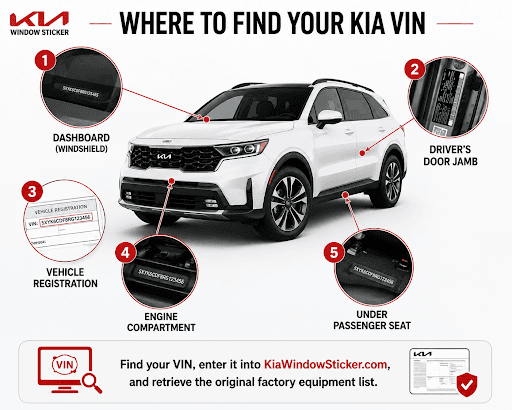
Once you've got the number in hand:
- 1.
- 2.Type in your 17-digit VIN.
- 3.Pull up a copy of the original Monroney label.
- 4.Scan the Standard Equipment column.
- 5.Check the Optional Equipment section.
- 6.Match the listed gear against the car you're looking at.
Running a quick lookup lets you verify:
- Original MSRP
- Exact trim level
- Factory-installed options
- Paint and interior color codes
- Engine and drivetrain setup
- EPA fuel economy numbers
- Safety tech and Drive Wise tools
When reviewing the document, just double-check that the printed VIN matches the car in person. If an advertised option like a sunroof or leather seats isn't listed on the sheet, it was likely added aftermarket or by the dealer later on.
READ ALSO: How to Tell if a Kia Telluride Is Really an SX Prestige (Using the Window Sticker)
Verify Your Kia's Equipment With Confidence
Understanding how a Kia standard equipment list differs from Kia optional equipment takes the guesswork out of comparing trims, evaluating used car values, and knowing what you're actually paying for.
Instead of taking a seller's word for it, run a window sticker VIN check on KiaWindowSticker.com to pull the original Monroney label. It takes just a couple of minutes to get a complete breakdown of your Kia's original MSRP, factory options, and build specs so you can buy or sell with complete clarity.